.png&w=384&q=75)
Schedule a Free Consultation
Request a free consultation now to discuss your treatment options at our modern clinic in Antalya Konyaaltı.
Get a Free QuoteWhatsApp ConsultationEndodontics (Root Canal)
Saving infected or deeply decayed teeth painlessly utilizing rotary instruments and three-dimensional warm sealing.
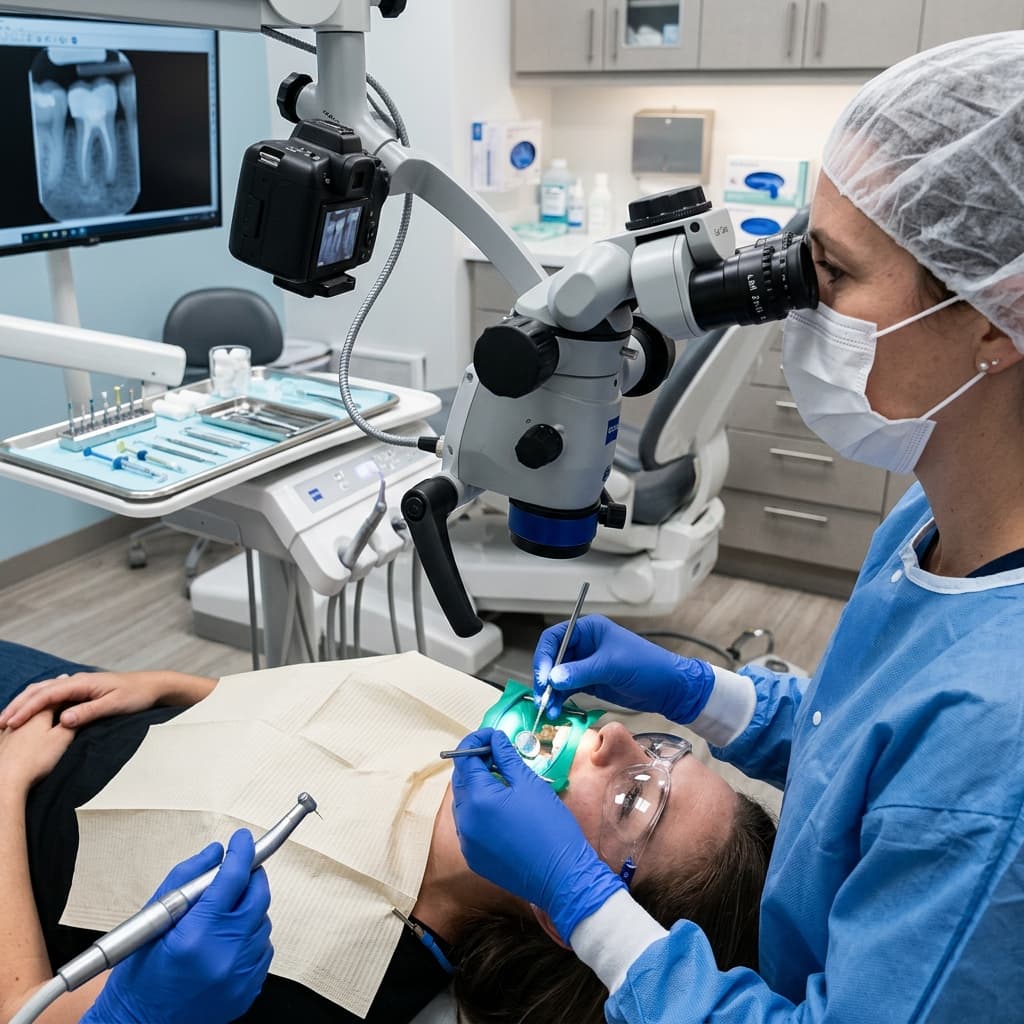
Endodontic treatment, commonly known as root canal therapy, is a highly precise and critical clinical procedure designed to salvage a natural tooth that has been severely compromised by deep decay, dental trauma, cracks, or chronic infection. At the center of every tooth lies the pulp chamber and root canal system, which contain the dental pulp—a delicate web of nerves, blood vessels, and connective tissues responsible for the tooth's development during its growth phase. Once a tooth is fully matured, the pulp's primary function is sensory. When this pulp is exposed to bacteria due to a deep cavity, micro-leakage under an old filling, or physical trauma that breaks the tooth, it triggers an inflammatory response. Because the pulp is enclosed within the hard, unyielding walls of dentin and enamel, this inflammation leads to elevated pressure inside the pulp chamber, causing severe, throbbing pain. Our clinical approach under the direction of Uzm. Dt. Yusuf Kurt focuses on eliminating infection, relieving pain, and sealing the canal space to preserve the structural integrity of your natural tooth and prevent the need for extraction. UNDERSTANDING PULPITIS AND CLINICAL PATHOLOGY: Pulpitis, the inflammation of the dental pulp, is clinically classified into two stages: 1. Reversible Pulpitis: The pulp is inflamed but remains healthy enough to save. If the underlying cause, such as a cavity, is removed and restored, the pulp heals. 2. Irreversible Pulpitis: The damage is too severe, and the pulp cannot recover. This stage is characterized by intense, spontaneous pain that worsens at night or when lying down, and prolonged sensitivity to hot and cold temperatures. If left untreated, irreversible pulpitis progresses to pulp necrosis (death of the tissue). The bacteria then migrate beyond the root apex (tip) into the surrounding periodontal ligament and alveolar bone, forming a periapical abscess, cyst, or granuloma, which can cause swelling of the face, bone destruction, and systemic infection. INSTRUMENTATION MECHANICS & ADVANCED NiTi ROTARY SYSTEMS: To ensure the complete removal of necrotic and infected tissues from the complex anatomy of the root canals, we utilize state-of-the-art endodontic technologies: - Rotary Nickel-Titanium (NiTi) Files: Traditional hand files are rigid and can cause root perforations or change the natural curvature of the canal. We utilize highly flexible NiTi rotary files driven by computerized endodontic motors with auto-reverse torque control. These instruments adapt to the natural curves of the root canals, allowing for safe, rapid, and efficient shaping. - Crown-Down Technique: We prepare the canals starting from the wider coronal portion and gradually moving down to the narrow apical tip. This technique reduces the stress on the instruments, prevents pushing debris out of the apex, and ensures excellent access for chemical irrigants. - Electronic Apex Locators: To determine the exact length of the root canals down to the millimeter without relying solely on 2D radiographs, we utilize electronic apex locators. This prevents over-instrumentation or under-filling of the canals. CHEMICAL IRRIGATION & ULTRASONIC ACTIVATION PROTOCOLS: Shaping the canals mechanically is not enough; the root canal system contains microscopic accessory canals and dentinal tubules where bacteria hide. Chemical irrigation is the most critical phase of root canal therapy: - Sodium Hypochlorite (NaOCl): We use NaOCl at precise clinical concentrations. It is a powerful antimicrobial agent that dissolves organic tissue remnants and necrotic pulp. - EDTA (Ethylendiamintetraacetic Acid): To remove the 'smear layer'—a film of organic and inorganic debris created on the canal walls during shaping—we apply EDTA. This opens the dentinal tubules, allowing the disinfecting solutions to penetrate deep into the dentin. - Sonic/Ultrasonic Agitation: Rather than simply rinsing, we activate the irrigating solutions using ultrasonic or sonic tips. The micro-vibrations generate acoustic streaming and cavitation, forcing the solutions into the microscopic recesses and accessory canals, ensuring a high level of disinfection. THREE-DIMENSIONAL OBTURATION & WARM GUTTA-PERCHA: Once the canals are shaped and sterilized, they must be filled to prevent reinfection. We utilize the warm gutta-percha vertical compaction technique. Gutta-percha is a biocompatible natural thermoplastic material. By heating the gutta-percha, we soften it, allowing it to flow and fill the irregular shapes, lateral canals, and apical deltas of the root system in three dimensions. This is combined with a resin-based or bioceramic root canal sealer, forming a hermetic seal that prevents any future bacterial ingress. POST-ENDODONTIC RESTORATIONS: A tooth that has undergone root canal therapy loses its vital moisture supply and becomes brittle, making it susceptible to fracture under chewing forces. Furthermore, significant tooth structure is often lost to decay or access preparation. - Fiber Post Reinforcement: If the remaining tooth structure is insufficient, we insert a prefabricated glass-fiber post into the root canal. Unlike rigid metal posts, fiber posts have an elasticity modulus similar to dentin, distributing chewing forces evenly and reducing the risk of root fracture. - Crowns vs. Overlays: For back teeth (molars and premolars) that bear heavy chewing loads, a simple composite filling is rarely sufficient. We recommend full zirconium crowns or CAD/CAM porcelain overlays/onlays to cover and protect the remaining cusps, restoring chewing function and guaranteeing long-term clinical success.
Root Canal Steps
Clinical Assessment & 3D Imaging: Diagnostic evaluation using digital radiographs and apex measurement to map the exact length and shape of the canals.
Anesthesia & Isolation: Administering localized anesthesia and placing a medical-grade rubber dam to isolate the tooth, keeping it sterile and dry.
Mekano-Chemical Instrumentation: Creating an access cavity, removing the inflamed pulp, and shaping the canals with flexible NiTi rotary instruments while continuously flushing with disinfecting solutions (NaOCl/EDTA).
Vertical Obturation & Reconstruction: Sealing the canals in three dimensions with warm thermoplastic gutta-percha and restoring the tooth structure with a fiber post, composite core, or full crown.
Key Advantages
Immediately relieves severe toothaches caused by nerve inflammation
Saves your natural tooth, avoiding the need for an implant or bridge
Prevents the infection from spreading into the surrounding bone
Highly successful, pain-free clinical procedure
Care After Treatment
Do not chew on the treated tooth until the final restoration (filling or crown) is completed. Some temporary sensitivity is normal for a few days.